

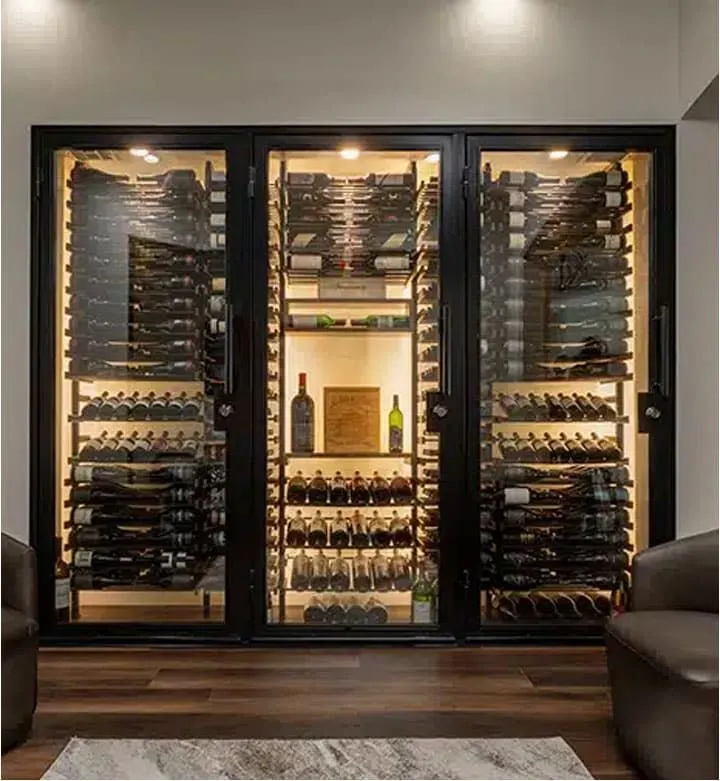
Not every house has a spare basement, and plenty of great cellars never go anywhere near one. Hallway niches, pantry corners and the dead space beneath stairs can hold a respectable number of bottles. If you’re gathering wine cellar design ideas for homes with little floor area to spare, think vertically and borrow space you already own, because creativity matters more than size.
Can a Staircase Really Hold a Cellar?
It can, and the results are often striking. The angled ceiling lets racks step down in length, so every inch of that triangle gets used. A collection of around 200 bottles fits under many ordinary staircases without much fuss at all, and the stepped shelving becomes a design feature all by itself.
The challenge is the framing. Stairs carry structural load, so the walls and insulation have to work around them. A builder will confirm what can be touched and what can’t before any cutting begins, which saves headaches and avoids unpleasant surprises later on when the stair itself is already open. Wasted corners often make the most memorable cellars.
Choosing a Door for a Tight Space
Swinging doors eat floor space, which is a real problem when every inch matters. Sliding or pivot wine cellar doors open without needing a clear arc, and they still seal well when fitted with proper gaskets and a firm threshold, so the cold stays where it belongs.
Glass panels keep a tiny room from feeling closed in. Pair them with interior lighting and a passerby sees a glowing display instead of a cupboard. Solid wood suits traditional homes that prefer a more private, understated entrance to the collection, and it hides the clutter that a small room can collect. Door choice shapes how the whole nook feels when you walk past.
What About a Closet?
Closets are the classic first conversion. They’re already framed, often have a light and an outlet, and can sit on an interior wall that stays naturally cool. With insulation and a snug door, an ordinary hall closet becomes a quiet little vault that costs far less than a full room build.
Keep the contents realistic, though. Most closets suit between 100 and 300 bottles. Beyond that, consider borrowing the adjoining wall or looking at a different location, because overpacking a small room makes airflow poor and bottles awkward to reach, and it turns every evening pour into a bit of a puzzle. Check the wall’s structure before assuming a closet is ready.
Does a Small Cellar Still Need Real Cooling?
Yes, and small rooms actually need more care. They gain and lose heat quickly, so a mistake shows up fast. Compact self-contained units and ducted mini-splits can be sized for tiny volumes without overwhelming the space or the electric bill, and they keep conditions steady even when the house heats up.
Noise matters when the cellar shares a wall with a living area. Ask about decibel ratings, and position the unit so it vents somewhere you won’t hear it humming during dinner or while the television is on. A little thought here prevents a daily annoyance you’d otherwise live with for years. A quiet unit keeps the nook pleasant to sit in.
Don’t Forget the Everyday Details
Small cellars live or die on convenience. A shallow shelf for a decanter, a hook for a corkscrew and a bit of counter space make the room feel like a real tasting nook, not just a storage cabinet that happens to hold bottles, and they make hosting far more enjoyable.
Lighting deserves attention too. Slim LED strips fit where bulky fixtures can’t, and a motion sensor turns them on as you approach. Little touches like these are what make a compact space feel generous, and they turn a simple nook into somewhere you actually want to linger for a while. A tiny shelf and a dimmer go a long way.
A Practical Next Step
Measure the area you’re considering, take a few photos and note how many bottles you own. With those three things, a specialist at customwinecellar.com can tell you quickly whether the spot is workable, what it might involve and roughly how long the whole job would take from start to finish.
Small cellars can look every bit as refined as large ones. What counts is thoughtful planning, not square footage, and a clever layout can make a modest room feel like a true destination in your home, one that guests remember and you use all the time. Nobody needs a basement to enjoy a proper collection.