

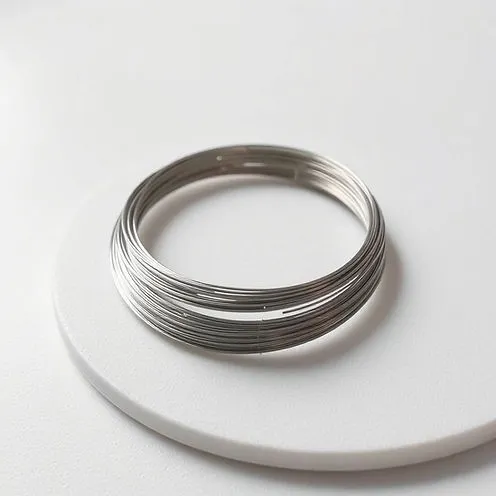
The key to precision engineering relies on picking strong materials that hold up well and work the same even under heavy stress. The choice of material can affect the precision and accuracy of the finished product, whether you are making a medical device, an industrial machine or a scientific instrument. The Nitinol Wire and the Nitinol Rod are made of nickel-titanium alloy and have many advanced properties, but are used for different engineering applications. Since they have different properties, knowing these differences aids engineers in selecting the right one for a certain application.
Understanding the Basics of Nitinol
The shape memory alloys (SMAs) such as Nitinol exhibit two interesting properties: shape memory and superelasticity. These traits help the stuff spring right back into shape after a flex, or give a little under load without taking a permanent bend when settings stay right.
Due to these properties, Nitinol has found extensive applications in areas with demand for lightweight, durable and flexible materials. Both Nitinol Wire and Nitinol Rod have these properties, but are more suitable for different applications because of their shape.
First, however, the user is required to understand the design requirements instead of just the material, in order to choose between them.
When Nitinol Wire Is the Better Choice
Applications like fine dimensions, repeated movement or flexibility generally call for Nitinol Wire. Being a small-diameter model, it can be used in small systems where space is a concern.
Engineers widely use wire for medical devices, small actuators, robotics, sensors, precision instruments and other applications. The material’s flexibility also means that it is applicable for prototypes and research projects where movement control is a key characteristic of the design.
It can sense temperature variation or mechanical loading, further broadening its application in the advanced engineering fields.
Where Nitinol Rod Offers Advantages
Nitinol Rod has higher cross-sectional strength than wire, but retains the ability of the alloy. In general, it is selected when the part needs to be machined, structurally supported or converted into a custom-made part.
Specialized engineering components, laboratory equipment, precision components and industrial prototypes are commonly made of rod material. It can also be used as the workpiece for creating complex shapes that cannot be directly created from wire.
Rod stock can offer more design flexibility during manufacture for projects that require higher mechanical stability requirements.
Comparing the Two Material Forms
Even if two parts share the same metal mix, their real outer shape still dictates how you apply them in the field.
Some practical differences include:
-
Nitinol Wire is better suited for flexible and compact designs.
-
Nitinol Rod offers greater strength for machined components.
-
Wire is commonly used where movement is required.
-
Rod is preferred for structural or precision-machined applications.
-
Both provide corrosion resistance and excellent durability.
The final decision will be based on the function to be performed on the component and will not be based on the fact that one product is always superior to the other.
Factors Engineers Should Evaluate
Engineers need to take into account the environment in which it will be used and the performance of the final product when choosing between the two materials.
Factors to consider are temperature range, flexibility needed, mechanical loading, required machining, dimensional tolerances, and long-life. The manufacturing techniques and finishing processes could also determine the two material forms.
Such factors can be reviewed at early stages of the design to minimize production issues and aid in engineering success.
Matching the Material to the Application
Each precision engineering project is different. The selection of Nitinol Wire or Nitinol Rod depends on how the material is to be used in the final assembly.
Wire is more suitable for projects that involve miniatures, flexibility or responsive mechanisms, whereas rod material will work better for projects that need rigid components or custom machining. Knowing these differences can help engineers make decisions to enhance performance and manufacturing efficiency.
Conclusion
Organizations looking into Nitinol Wire and Nitinol Rod for their engineering, industrial and scientific applications will find useful information on regmetals.com. Before entering into production, the performance of material forms can be evaluated, and key production issues can be addressed before starting to produce unstable components. For projects that demand special shape memory alloy materials, you may need to get some advice from a seasoned seller to determine the right one for your needs.